The Robinson Professors

September 2012 Accolades

Robert Hazen, Robinson Professor of Earth Sciences, presented a lecture on mineral evolution at the University of Arizona. He has been named the 2012 Condon Lecturer of Oregon State University and a 2013 Linus Pauling Lecturer by the Institute for Science, Engineering and Public Policy.

Steven Pearlstein, Robinson Professor of Public and International Affairs, participated in a panel discussion on the political and media environments for federal budget policy at the annual meeting of the Academy for Government Accountability held at Mason’s Arlington Campus.

Laurie O. Robinson, Robinson Professor of Criminology, Law and Society, wrote the forward in a newly published volume, “From Juvenile Delinquency to Adult Crime” from Oxford University Press. She recently received awards from two national organizations for contributions to the criminal justice field: SEARCH, the National Consortium for Justice Information and Statistics, presented its Justice Policy Leadership Award to her at its annual conference in Cincinnati in July, and the National Criminal Justice Association bestowed its Career Service Award on her at its annual meeting in Albuquerque, also in July.
August 2012 Accolades

Robert Hazen, Robinson Professor of Earth Sciences, presented lectures on “Unanswered Questions in Deep Carbon Research” at the Alfred P. Sloan Foundation in New York, the Geochemical Society meeting in Montreal, and the Jet Propulsion Laboratory in Pasadena. He also presented lectures on “Mineral Evolution” at Boston College, MIT, the Geochemical Society meeting in Montreal and the National Science Foundation.

Hugh Heclo, Robinson Professor of Public Affairs, coached high school students from the Maggie L. Walker Governor’s School representing Virginia in the “We the People, the Citizen and the Constitution” competition held annually in Washington, D.C. They won second place in this national championship competition.

Carma Hinton, Robinson Professor of Visual Culture and Chinese Studies, introduced her award-winning documentary, “The Gate of Heavenly Peace,” at a screening at The Museum of Chinese in America in New York.

John Paden, Robinson Professor of International Studies, presented “Postelection Conflict Management in Nigeria,” to the Council on Foreign Relations.

James Trefil, Robinson Professor of Physics, presented “Copernicus and Copernicium 112” Plenary Address at the Polish American Arts Association. He also wrote “Problem Sets” with Sarah Swartz for Physics Today, May 2012; “The Planet in a Pebble” for “Quarterly Review of Biology, June 2012; and “Space Atlas: Mapping the Universe and Beyond,” for National Geographic Books. He was named editor in chief of a multivolume reference work on scientific discovery to be published by MacMillan/Cengage.

Professor Robinson Sits Down with The Crime Report

New Robinson Professor, Laurie Robinson, was recently interviewed by The Crime Report regarding major issues in criminology today and her work in the Justice Department.

From the interview:

“The Crime Report:  You’ve mentioned on many occasions that you are an advocate of evidence-based programs. How much progress have we made on that front in the criminal justice area?

Robinson:  We have made progress, but I completely agree with those who said at the recent Jerry Lee Symposium on Crime Prevention that we still have a good road ahead of us that we need to go down. If we look back 10 or 15 years, we can see that we have traveled a good way. I remember back in the 1990s it was very common for organizations to come out with lists of best practices or local programs they thought were good.  This was based on mostly anecdote, however.

People are much, much less apt to do that now, because there is more understanding that programs need to be evaluated and there needs to be some kind of evidence, measures that prove things work. There still must be education on what constitutes evidence and what kinds of measures need to be produced.

I think the criminal-justice field, particularly police and corrections—the front and back ends of the system, less so in the adjudicatory part—practitioners are far, far more sophisticated about realities of evidence-based programs. The field is open to and demanding evidence-based programs.

I am given a lot of credit for advocating this when I came back to DOJ in 2009, but the field was really ripe for it. I was announcing a platform that everybody out there was ready for.  Much more needs to be done, but the reception to crimesolutions.gov— OJP’s “what works” clearinghouse—has been terrific.”

You can locate the full interview here.

An Interview with Robinson Professor Steven Pearlstein

This summer, Professor Pearlstein was interviewed by the Mason News Desk about his first year of teaching at Mason.

From the interview:

“You’re a full-time professor but you still do a demanding column for the Washington Post, a job many would find full-time in itself. How do you manage the time?

I’m not a good juggler. I’m here four days a week, and then on Thursdays at noon I turn into a columnist. I usually leave, but sometimes I close the door here and become a reporter, and I write the column on Friday afternoon. I have a research assistant who helps me. But if you do [this kind of work] long enough, you can do it relatively quickly. Since I’ve been at Mason, my column has gotten longer, and people ask if that’s intentional. No it’s not intentional, it’s because I don’t have time to make it shorter.”

Click here to read the full interview.

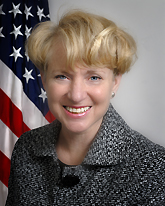
Laurie Robinson to Become Newest Robinson Professor in the Fall

Photo courtesy of US Dept of Justice

Laurie Robinson will become the Robinson Professor of Criminology, Law and Society this fall. She has twice served as a Senate-confirmed, Presidentially-appointed Assistant Attorney General for the U.S. Department of Justice Office of Justice Programs. Her three years of service in the Obama Administration, coupled with seven years in the same post in the Clinton Administration, make her the longest serving head of the agency in its 45-year history. Between her stints in the Justice Department, Robinson launched, and then directed, the University of Pennsylvania’s Master of Science Program in Criminology and served as a Distinguished Senior Scholar in Penn’s Jerry Lee Center of Criminology. She will be teaching CRIM 790, a capstone course for students pursuing a new concentration on Criminology Policy and Practice within the Department of Criminology, Law and Society’s MA program.


Click here for more information.

Professor Crew Appointed as OAH Distinguished Lecturer

Professor Crew has been appointed as an OAH Distinguished Lecturer. He is one of twenty-five speakers to join the program for the 2012-13 year. OAH lecturers speak at college campuses and conferences, as well as historical societies, libraries, museums, and teacher workshops. The OAH, Organization of American Historians, was founded in 1907 and it “is the largest professional society dedicated to the teaching and study of American History. The mission of the organization is to promote excellence in the scholarship, teaching, and presentation of American history, and to encourage wide discussion of historical questions and equitable treatment of all practitioners of history.”

More information about OAH can be found by visiting: http://www.oah.org/about/

To see a full list of the lectures, please visit: http://lectures.oah.org/lecturers/new.html

Of Slaves and Ships: Students Trace the Route of Pearl Escapees

Of Slaves and Ships: Students Trace the Route of Pearl Escapees

By Buzz McClain

“If you look over there, you can see the Capitol building,” Mason historian Spencer R. Crew said, pointing to the right windows of the van. “And over here, to the left, there were slave pens. It’s pretty amazing to think there were slave pens this close to the Capitol.”

Crew, tall, lanky, and with an easy smile, guided the April afternoon tour that took 19 students, many of them history majors, to landmarks related to the ill-fated and decidedly short voyage of the Pearl, a three-masted schooner hired to secretly take 77 escaped slaves—men, women, and children—from Washington, D.C., to freedom in Pennsylvania in April 1848.

The story of the Pearl is vividly told in the riveting  book Escape on the Pearl: The Heroic Bid for Freedom on the Underground Railroad by Mary Kay Ricks. The slaves never made it to Pennsylvania. In fact, they barely made it out of Washington before they were stopped by uncooperative winds and an armed posse in a steamer brought them back to the wharf. The ensuing violent mobs, death threats, and heated politics brought the slavery issue to a boil in Washington.

Few are more qualified to lead such a tour than Crew, a sought-after expert and author on the history of the Underground Railroad and abolition, whose remarks at each of the 11 stops put the adventure of the Pearl into sharp context for the students.

Photo by Alexis Glenn/Creative Services/George Mason University.

“When you think about being a historian, it’s good to get an idea of how we connect then with now,” said Crew, Mason’s Robinson Professor of American, African American, and Public History, from the front of the van as it made its first stop: the wharf on Washington’s Southwest Waterfront. At the dock, Crew pointed past the small private boats bobbing on the water and had the students imagine what it must have been like 164 years earlier as the slaves trekked across town to reach the ship.

“Imagine walking from Georgetown to here in the dark so you couldn’t be seen,” he said, trying to imagine it himself. The distance is nearly four miles, and after the tour several of the students commented on how their own voyage that afternoon put the scope of the slaves’ ordeal into perspective.

The van continued up Seventh Street, past the site where the returned slaves were held in pens and the ship’s captain was attacked with a knife by a bystander. The van then crossed the National Mall where the Edmonson sisters, Mary and Emily, and four brothers walked on their way to the Pearl from their home—and back, as it happened, not much later. The tour also stopped near the Verizon Center where the editor of the abolitionist newspaper New Era was confronted and threatened by raging mobs and the Asbury United Methodist Church where the Edmonsons worshipped and money was raised to buy their freedom.

The van parked in Georgetown, and the students followed Crew along the vintage brick sidewalk to Mt. Zion Methodist Church where they read the plaque describing it as “the first Methodist church for blacks.” On the corner, they gazed at a blue house at 29th and O streets once owned by Alfred Pope, a Pearl fugitive. It was blue then, and it remains blue, no doubt a contingency by the Georgetown history keepers.

The passengers grew animated with conversation as the van continued past the still-standing Dodge warehouse, now a Wisconsin Avenue retail complex (Francis Dodge Jr. had three escapees on the Pearl; it was his steamer that brought them back) and across the river toward Alexandria for the final stop on the tour.

The gaggle stood on Duke Street reading the historic marker that identified the building at 1315 as the offices of Franklin and Armfield, “one of the largest slave dealers in the country.” In the 1830s, thousands of slaves were transported from here each year to New Orleans, a dreadful destination in the Deep South. Surrounded today by ice cream shops and tee-shirt vendors, it was difficult to imagine the sight of shackled slaves shuffling to their auctions, but Crew did his best to remind the students of period conditions.

“See if you can figure out the irony of this building,” Crew said, giving the students a moment to study the marker and the façade. When no one spoke up, Crew was a little surprised. The giveaway was the bronze plaque identifying the current occupant, the Northern Virginia Urban League.

“It’s like a local version of the NAACP,” Crew explained. “Think about what the building stood for and how things have changed over time.”

Crew led the students around the block where they were stopped in their tracks by a sculpture, and a fitting finale to the tour: larger-than-life bronze images of Mary and Emily Edmonson, standing near a former slave pen (now a real estate office) where they were kept for sale. The sisters, who seem to emerge out of a jagged boulder, gaze defiantly down the street that ends at the African American Heritage Park. Only a small plaque at the base notes who the subjects are.

“Wow, look at this,” one of the students said from behind the rock.

“You can hardly see it,” said another as she rubbed the bronze. It was a small etching of a three-masted schooner, and two feet below it, the word Pearl.

If this was an artistic exercise in memorial restraint, Crew wasn’t impressed. “It definitely should be bigger,” he said. “Maybe next year that will be our project, to design a better memorial for the Pearl.”


May 2012 Accolades

Robinson Professors

Robert Hazen, Robinson Professor of Earth Sciences, presented keynote lectures on “What Minerals Were Present at Life’s Origins?” at the Astrobiology Science Conference in Atlanta, and on “Mineral-Molecule Interactions” at the American Chemical Society meeting in San Diego.

Carma Hinton, Robinson Professor of Visual Culture and Chinese Studies, had a number of her films screened in Beijing as part of a documentary film series about the representation of China by Western filmmakers. The series was sponsored by the Italian Embassy in Beijing through its Italian Cultural Institute. The titles included “Small Happiness: Women of a Chinese Village”; “Abode of Illusion: The Life and Art of Chang Dai-ch’ien”; “Creative Exchanges: Sights and Sounds of the Silk Road”; and “Yin Yu Tang: A Chinese Home.” Her film, “The Gate of Heavenly Peace,” was screened at the University of Washington as part of a lecture and film series titled “Images in Crisis: The Politics of Visual Representation in the Twentieth Century and Beyond.”

John Paden, Robinson Professor of International Studies, published his newest book, “Postelection Conflict Management in Nigeria: The Challenges of National Unity.” He also presented a lecture to the U.S. Department of State’s Conflict and Stabilization Office on “Postelection Conflict Management in Nigeria,” testified to the U.S. Commission on International Religious Freedom on “Religious Extremism in Nigeria” and presented a lecture to the World Bank’s Africa Region Office on “Religious Extremism in Nigeria.”

Steven Pearlstein, Robinson Professor of Public and International Affairs, presented the keynote address at the Seventh Annual Award for Journalism in Recognition of Architecture/Engineering Achievement at the Northern Virginia Post of the Society of American Military Engineers. He also moderated a discussion with international business and policy leaders regarding financial and economic trends around the globe at the Export-Import Bank of the United States 2012 Annual Conference and presented the Department of Public and International Affairs’ annual Gortner Lecture, “The Politics of Polarization: A Modern Tragedy of the Commons.”

James Trefil, Robinson Professor of Physics, presented the opening lectures on scientific methodology at the Judicial Symposium on Scientific Evidence in the Courts held by Mason’s Law and Economics Center. His topics were “The Scientific Method,” “Elements of Scientific Decision Making” and “The History of the Use of Expert Witnesses.”

Professor Pearlstein Gives the Annual Gortner Lecture

On Monday, April 16th, Professor Pearlstein gave the annual Gortner Lecture. This lecture is sponsored by the Department of Public and International Affairs. Every year, PIA honors a professional active in the field of public affairs and asks him or her to share insights with the Mason community. Professor Pearlstein gave a talk on “The Politics of Polarization: A Modern Tragedy of the Commons.”

Click here to read the Prof Pearlstein’s lecture.

How Obamacare Will Save American Healthcare

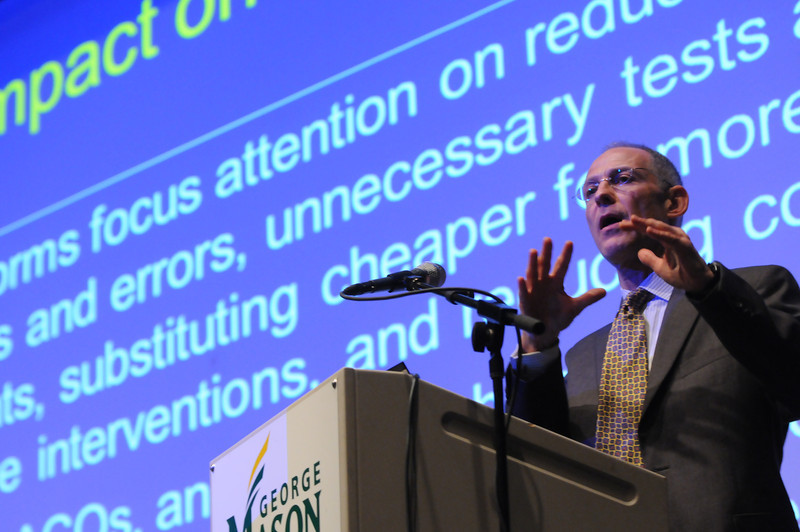
Dr. "Zeke" Emanuel spoke on Obamacare at an open meeting of Prof. Pearlstein's GOVT 319 class.

Ezekiel “Zeke” Emanuel, one of the architects of the Obama health reform plan, spoke on “How Obamacare Will Save American Healthcare,” on Monday, April 16, at 1:30 p.m. in the Johnson Center Cinema.

The lecture was sponsored by the Department of Public and International Affairs and the Center for Health Policy Research and Ethics.

Emanuel is an oncologist and former chairman of the Department of Bioethics at the National Institutes of Health.  From 2009 until 2011, he was a key player in the White House health reform team, assigned to the Office of Management and Budget. (His brother, Rahm, was White House chief of staff and is now mayor of Chicago.) Emanuel’s writing on health policy issues appears regularly in the New York Times. He is also a commentator on MSNBC.

Last year, Emanuel was appointed chairman of the Department of Medical Ethics and Health Policy at the University of Pennsylvania, where he now teaches in both the medical and business schools.

The talk was offered as an open meeting of the class GOVT 319 Issues in Government and Politics: Money, Markets and Economic Policy, taught by Steven Pearlstein, Robinson Professor of Public and International Affairs.  A question-and-answer period followed the presentation.